Category Archives: Uncategorized

Go country on an electric train!

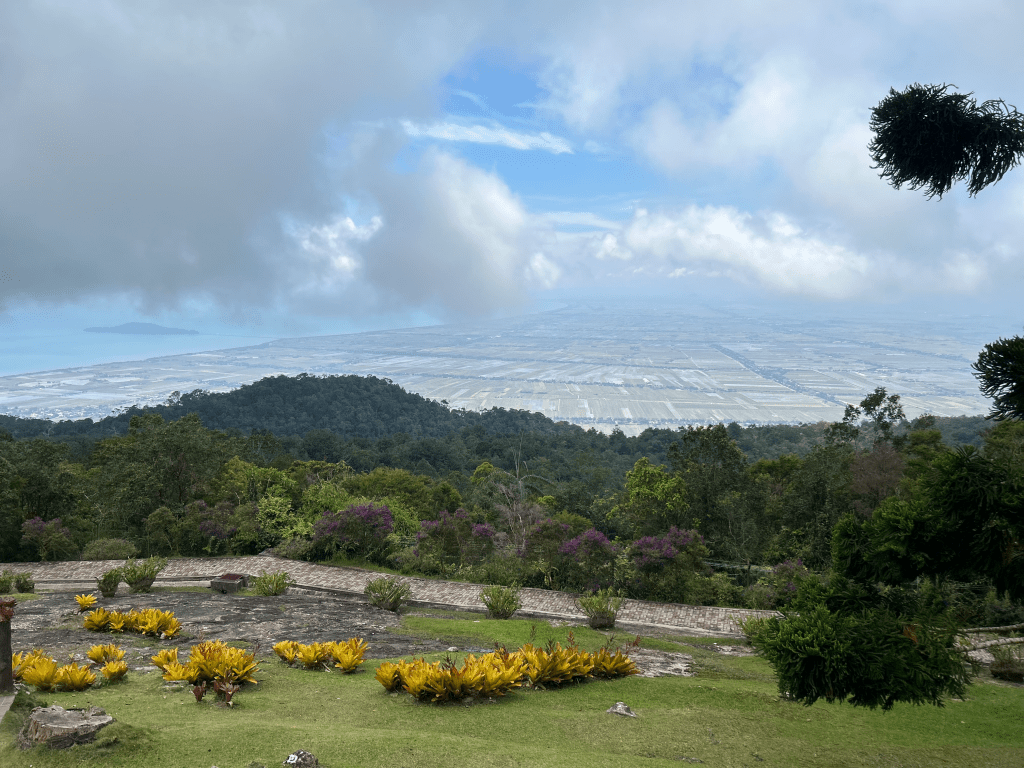
Kedah padi fields from Gunung Jerai

Just to break the routine of the same-same (local politics was getting tiring since it was going nowhere!), I went on the electric train upcountry to Gunung Jerai in Kedah last Monday. It was my first ride on an electric train and a pleasant experience in packing sightseeing all in a day!

The train left KL Sentral at 7.20am and arrived in Ipoh at 9.30am, enough time for a morning snooze, and sleep-restored, I was ready for the day’s outing! I went with a group who were joined by a few others in Ipoh who also brought with them packed nasi lemak for breakfast.

There is a bar-styled cafeteria on the electric train but it serves 2in1/3in1 drinks and packaged meals. If that’s not your preference, bring your own drinks and snacks. I bought two McD coffees, poured them into a small flask and enjoyed it with snacks throughout the journey!

If you plan your trip properly, you can get off at Ipoh, sight see there and have a good meal before resuming the journey on the next train to your destination.

We didn’t get off at Ipoh as we were heading to Sungai Petani as the train doesn’t stop at Gurun from where we drive to Gunung Jerai.

Another two hours on the train and it whizzed past plantations, tree and trees, swamps, kampungs. Occasionally, we caught glimpses of the Titiwangsa Mountains. The scenery was of an old world like in Teluk Intan (old name is Teluk Anson) where I had spent my early years and which I forgot with all the development in the Klang Valley where I now live that crowded out those memories of a past world!

Sitting relaxed in cushioned seats, watching that world fly past was a reminder of how fast the urban areas in Malaysia have developed, yet, some areas remain refreshingly intact — hopefully, with the benefits of modern amenities.

The most beautiful scene we went through was after Ipoh, when the train cut through on elevated tracks across Malaysia’s first man-made lake, the Tasik Bukit Merah. The lake was built in colonial times in 1906 to impound water to irrigate the surrounding padi fields. The tracks for the electric train was built in 2013.

View of Tasik Bukit Merah from the train

Within another two hours, we reached Sungai Petani, got off, and took the pre-arranged bus to the Gurun railway station. Waiting vans took us up a winding road to a landing area on Gunung Jerai where the Gunung Jerai hill resort is situated. The summit is inaccessible.

There were shops outside the resort but they were closed. We had prepacked lunches, then walked up to the built-up resort area which opened up to a panoramic view of Kedah’s rice fields. There’s an entrance fee of RM2 per person to get into the resort area. Or pay RM5 per person for a car-cart ride to the resort for those who don’t want to walk.

When we were there, it was cloudy. It seems on a clear day visitors can see Langkawi over the sea in the distance.

It’s a pretty resort with stunning wild purple flowers lining the 15-minute walkway to the viewing areas. It also has a cafe selling drinks, cakes and snacks. And clean toilets!

Then, in vans we came down to the Gurun railway station to take the train back to Ipoh where we spent a night.

The Gurun railway station is small but at its entrance you get an outstanding view of country beauty. The station is surrounded by groves of trees with homes nestled among them. Beyond are the towering rain-forested mountains! I was so captivated by the view that I forgot to take pictures!

In Ipoh, we stayed at a fancy hotel, had a great breakfast the next day, walked around and had lunch and then went to the Ipoh railway station and took the train back home.

The train ride was enjoyable with comfortable seats and clean coaches — even the toilets were clean! I have only one complaint about the train. The overhead luggage rack was sooty, stirring up dirt and dust when luggage is pushed in with some of that stuff falling onto your clothes. That’s something that KTM, which runs the trains, needs to clean up! Otherwise, no other complaints!

I went with a group of adventurous boomers, who were good company, chatting, laughing, singing along in the train (some even dancing!) and dancing away in a session in a room we booked after dinner to let our hair down!

It was a short but well-spent one-night trip, memorable for the fun-filled company we kept and a sweet reminder of the old-country charm of where we come from.

A leaders-imposed angst people don’t need

Early last month, Warisan president Shafie Apdal sent a warning to Sabah governor Musa Aman that he would take the latter to court if Warisan wins the upcoming state elections with a simple majority but is denied the right to form the state government with him as chief minister (CM).

Warisan plans to contest all 73 seats in the Sabah state elections that must be called within 60 days of Nov 11 this year, when the state assembly automatically dissolves.

The Sabah party is hopeful of winning a simple majority but Shafie’s warning is a reflection of the uncertainty of validating the electoral outcome because of an amendment to the state laws on the appointment of the CM and the state government.

Article 6(3) of the Sabah state constitution states: “The Yang di-Pertua Negeri shall appoint as Chief Minister a member of the Legislative Assembly who in his judgement is likely to command the confidence of a majority of the members of the Assembly.” In Sabah the governor is called the Yang di-Pertua Negeri.

This law remains intact. It is in line with Article 43(2)(a) of the federal constitution which states:  the Yang di-Pertuan Agong (the King) shall appoint a Prime Minister who, in his judgment, is likely to command the confidence of the majority of the members of the Dewan Rakyat.

Article 6(3) of the Sabah law, however, had another law, Article 6(7), that provides a clear instruction on how the CM is chosen. Article 6(7) states: “For the purpose of Clause (3) of this Article, where a political party has won a majority of the elected seats of the Legislative Assembly in a general election, the leader of such political party, who is a member of the Legislative Assembly, shall be the member of the Legislative Assembly who is likely to command the confidence of the majority of the members of the assembly.”

Article 6(7) however — despite a great deal of furore, especially by the Opposition party Warisan — was repealed in May last year. This means the Sabah governor can now appoint any member of the state assembly who, in his judgement, is likely to command the confidence of the majority of the Assembly, whether or not that candidate actually has the numbers.

When Article 6(7) was deleted, the clarity it gave to Article 6(3) was removed. In its place is an ambiguity that is left to the governor to resolve, and that is the source of the angst Sabah parties not aligned to the governor are feeling and the reason for Shafie’s warning.

Musa is or was an Umno strongman in Sabah, and the fear is that Umno even without a simple majority may be chosen to form the state government on the basis that with its allies it “is likely to command the confidence of the majority of the Assembly”.

While this is sheer speculation until proven otherwise after the Sabah state elections, such a precedent occurred at the federal level, not once but twice. In 2018, after the Sheraton move, Muhyiddin Yassin of Perikatan Nasional (PN) was appointed PM even though resigned PM Tun Dr Mahathir Mohamad claimed he had a majority.

In 2022, after the general elections, when the coalition Pakatan Harapan (PH) won the most seats but was unable to form a majority government because Sarawak’s GPS and Sabah’s GRS were allied with PN giving it a simple majority, PH’s leader, Anwar Ibrahim, was appointed PM, after which the then king spoke to the other parties, and GPS, GRS and Umno joined forces with Anwar.

The argument to justify the king’s action was Article 40(2)(a) of the federal constitution which states: “The Yang di-Pertuan Agong may act in his discretion in the performance of the following functions, that is to say: (a) the appointment of a Prime Minister”. 

Whether the king’s discretion means he has absolute power to appoint a PM by royal decree, or to disregard another MP’s claim of a simple majority, or to suggest the formation of a unity or any other kind of government, or direct or advise political parties to join whichever party or coalition to form a majority is something for constitutional law experts to sort out and will not be discussed here.

What is suggested here is that the ambiguity of the existing laws, whether at the federal or state levels, imposes a stress on voters. Voters have no certainty that the team they vote for, whose head they support as the next PM or CM or Mentri Besar (CM in Peninsula states), will be respected by the king, governor or sultan.

In this scenario, voters may think that their votes do not count and it may disincentivise them to vote. They are now not free to choose the leaders of their choice because that choice may be overruled by the king, governors or sultans who may be acting according to the provisions of the law but the elected leaders are failing to ensure that the laws are interpreted and applied to defend and uphold the democratic choices of the voters as espoused in the federal constitution.

In a democracy, voters should never go to the polls with the uncertainty that their vote won’t count. And it is the leaders who must ensure that the people’s votes count.

The fact that the voters’ elected representatives in Sabah chose to constrain the voter’s free choice shows that their elected representatives are more interested in forming a government by appointment rather than on the mandate of the people. It’s the same with leaders at the federal level.

The majority of Malaysian voters may not understand that their democratic rights are protected by the federal constitution and so may not fight for them. All the more reason why the leaders must fight on their behalf to protect those rights — not maintain a guilty silence, like the people have been witnessing.

Shafie has vowed that if his party wins the Sabah elections and he can form a government with a simple majority, he will restore Article 6(7).

The Sabah election will show if the voters understand their democratic rights and vote for a party/coalition that restores that right. If they do, it is an encouraging sign that the voters know their rights and will support the party that respects it.

Perhaps, at the federal level, we need a law like Article 6(7) so that a PM is chosen on the evidence of majority support from the Dewan Rakyat. Perhaps, like, Warisan, a Peninsular party/coalition will promise to introduce such a law.

Then, there will be clarity in appointing a PM with the mandate of the people. The people deserve no less

Akmal bombast fizzles out; PM reacts after

The usually wordless Prime Minister Anwar Ibrahim with regard to 3R (race, religion and royals) issues, today urged that strong action be taken against those who incite hate.

Speaking at a civil service assembly in Putrajaya, he instructed enforcement agencies to act against those fanning hate.

It is a surprising reaction from the PM considering the fact that in the past two years of his term as PM he has maintained a frustrating silence on 3R-related public issues. Perhaps, he has finally been correctly advised that if he didn’t say anything, things may get out of hand. With regard to the current issue, however, his instructions came too late to make a difference.

The PM’s comments came on the heels of a hyped-up gathering last night in Kepala Batas, Penang, over a mistake in flying an upside-down Malaysian flag by an unsuspecting citizen. A video of a hardware shop owner hoisting an upside-down Jalur Gemilang with another man recording it went viral a week ago.

It triggered a barrage of criticisms, with Umno Youth chief Akmal Saleh picking up the issue as a desecration of the national flag and demanded that the authorities take police action against the hardware shop owner, who had explained that it was a mistake because he was just trying out the flag. He later hung the flag correctly.

But Akmal was not placated. He went on a relentless tirade, berating the hardware shop owner as a traitor and threatening to converge at his shop to “teach” him how to fly the flag if the authorities failed to act.

His taunts got the DAP to go to the defence of the shop owner. DAP leaders stressed that it was a mistake and that they would not tolerate bullying and intimidation but Akmal showed no sign of backing down. He lamented that the Chinese were united behind the shop owner but that the Malays were not.

This Russian-trained doctor just could not see his words, attitude and action for what they really were, but seized the issue of a flag error to turn it into a racial issue. The exasperated DAP finally said they, too, would gather at the hardware shop — but to distribute the Malaysian flag.

So, both parties, components of Anwar’s so-called unity government, headed for a showdown at the hardware shop. Despite the heated exchange of words, there was no comment from Anwar.

A day before both parties were to meet at the hardware shop, the police asked both sides to cancel their plans. Lawyers for Liberty (LFL), however, said they would turn up to provide free legal services.

Last night (Thurs, Aug 14) was when the “meeting” took place. According to reports, all the shops shuttered down early.

Akmal later came with his supporters of a couple of hundred. Bersatu Youth also came with their supporters to show Malay solidarity. LFL came with placards urging Umno Youth not to be like zionists. But DAP did not turn up. Its veterans’ club members, instead, came to distribute flags.

According to media reports, Umno Youth held its gathering not outside the hardware shop but a little way away. The only incident of worth was that Umno Youth leaders were not happy with LFL’s placards and asked to take them down and they would go away. LFL complied and the crowd dispersed. No untoward incident.

LFL’s presence, led by its leader Zaid Malek and DAP’s absence presumably defused tensions in the absence of national leadership.

Everyone, Umno Youth, LFL and the DAP, no doubt, have the right to assemble. But when a group wants to assemble in front of a citizen’s house or shop over a mistake, that amounts to threatening a citizen’s life and privacy and is inexcusable.

It should have been prevented and the PM should have taken steps in that direction before, not after the event.

In this case, Anwar was lucky because the turnout of Umno Youth supporters was, some say, 100, and others 300. After all the bombastic words from Akmal, the turnout was relatively small. If it had been much larger, the outcome might have been different.

Perhaps that is the reason for Anwar’s post-event comments. They are a warning that any future gathering, big or small, inciting racial disharmony will face action by the authorities.

One positive thing, however, needs to be noted about the turnout of Akmal’s supporters. It was smaller than expected. The size may be indicative of an emerging trend: that more and more Malays do not really identify with the strategies that Malay leaders like Akmal use.

Perhaps, the majority of Malay voters don’t really care for racial politics and it is time for Malay leaders to step away from racial politics and come up with real issues that appeal to the people to win their support.

What the Turun Anwar rally means

Tonight (July 26), a mammoth “Turun Anwar” rally is being planned to call for the resignation of Prime Minister Anwar Ibrahim. Organised by the Opposition, Perikatan Nasional (PN), the rally is expected to attract thousands.

PN component partner Bersatu’s deputy president Hamzah Zainuddin claimed in Parliament that he expects about 500,000 people to attend the rally at Dataran Merdeka. If such a figure did turn up at the rally, Anwar will be faced with the daunting prospect of recognising the will of the people and stepping down or defying the people and staying on as PM.

PN may be confident of a large turnout based on feedback from the ground. Realistically, however, that figure may be hoped for rather than expected. If 500,000 people do turn up at the rally, it would be a very clear indication of the discontent on the ground and it would do well for Anwar to heed what the people want.

Even if the turnout was less than expected, even if it is only 10,000 or even less, Anwar has to take note of it seriously. A smaller crowd does not mean that the discontent is limited. It could mean the tip of the iceberg and Anwar should not wait until the submerged iceberg of discontent swells up and sweeps over!

Nevertheless, Anwar has dismissed the rally, saying that it doesn’t mean anything as his administration is intact. He has also said that he would not step down unless he loses a confidence vote in the Dewan Rakyat. It was reported in the media that he has instructed the Speaker of the Dewan Rakyat to agree to a confidence or no-confidence vote should the MPs call for one.

A confidence/no-confidence vote in the Dewan Rakyat is the conventional means of removing a prime minister from office. In the current political scenario, however, even if the Speaker allows for one, the government MPs will not be free to vote according to their conscience and the outcome would likely favour the incumbent PM, for just one reason. The political parties which joined Anwar’s Pakatan Harapan (PH) coalition to form a majority government are bound by a Memorandum of Understanding (MoU) where they promise to support him for a full term. In exchange they got benefits.

So, Anwar’s deceptive confidence is understandable. The MoU will ensure he wins a confidence/no-confidence vote so he can appear magnanimous in inviting MPs to call for one knowing he will pass the test.

That direction to the Speaker to accommodate a call for a confidence/no-confidence vote, however, reveals the PM’s lack of interest in resolving the issue of a hung Parliament or the need to prove a PM’s majority support in the House. It amounts to executive interference. His direction indicates that the Speaker is not independent.

As a PM who claims to be a reformist, Anwar would have proven his word true if the first thing he had done after being appointed PM was to implement a process by law to call for a confidence/no-confidence vote to solve the urgent issue of a hung Parliament and in choosing a PM with the majority support of the Dewan Rakyat.

With a two-thirds majority, albeit by an undemocratic MoU, he could have easily done it. The fact that he didn’t simply shows that he himself wasn’t confident of his purported majority support of the MPs.

Now, if the PM is sincere, he would cancel the MoU, free the MPs to vote as they wish, set in place the proper process to call for confidence/no-confidence vote and leave it to the MPs to decide what to do.

Since he hasn’t done that and if today’s rally draws thousands, Anwar has to consider their request and resign. If he fails to do that, the Opposition now has very strong grounds to lobby government MPs to support a call for a confidence/no-confidence vote on the grounds that a large segment of the people have no confidence in him.

MPs who understand the democratic principle of accountability will support PN unless they want to lose their voters. It is not worth risking that.

Today’s rally will have a bearing on Anwar’s future as PM.

A path back to rule by the mandate of the majority

Of late, there has been an increase in criticisms against Prime Minister Anwar Ibrahim, including calls for him to resign or take a leave of absence. Anwar’s premiership has been marked by criticisms from Day 1, but these calls amidst the criticisms have become more frequent, especially after a couple of events that paint the PM in a very poor light.

The first involved Anwar seeking a ruling by the High Court to refer to the Federal Court to determine legal questions as to whether a PM has immunity against civil suits. It may appear as a legitimate query by a PM, except for the fact that it was a sitting PM with a sexual assault case pending against him in court who was seeking such immunity.

Few bought his argument that his action was an attempt to protect the institution of the Prime Minister’s Office. Most saw through his guise.

Early this month, the High Court dismissed his attempt as “baseless claims” but Anwar is appealing.

This was followed by another court decision involving his former aide, Yusoff Rawther, who had taken the sexual assault case against Anwar. While the case was pending, Yusoff was slapped with charges of drug trafficking and possessions of two imitation pistols and held in remand for nine months but was acquitted of both charges by the High Court on June 12, suggesting they were trumped-up charges.

Soon after that, the news leaked out that a senior judge was reported to have been questioned by the Judicial Appointments Commission (JAC) for allegedly being involved in judicial interference. The Bar Council announced on Wednesday that it was seeking High Court orders to get the minutes of the JAC meeting in May to ascertain the allegations of judicial interference.

The response to these actions has been intense. Online criticisms are heavily slanted against Anwar, with many calling for his resignation and expressing their sense of betrayal that his promised reforms were not delivered. Opposition leaders have repeatedly urged caution over these issues involving alleged abuse of power.

Two days ago, two-time former prime minister Tun Dr Mahathir Mohamad lent weight to the issue of judicial interference by holding a roundtable discussion by the Secretariat to Defend the Judicial System which called on Anwar to declare that he has a conflict of interest and to recuse himself from the process of appointing senior judges.

The secretariat proposed that Anwar take a leave of absence until Yusuff’s lawsuit against him was resolved.

Another event that seriously damaged Anwar’s image as a reformer with popular support was when about 100 Universiti Malaysia Sabah students held an anti-corruption rally in Kota Kinabalu on Sunday at which they burned Anwar’s caricature. The students held the rally to protest against the lack of action taken against corruption in Sabah.

In a thriving democracy, a beleaguered PM whose decisions are constantly criticised would either resign or seek a confidence vote to test his support. Or, fellow MPs will call for a confidence vote.

In Malaysia, there is no provision by law to call for a confidence vote unless the PM calls for it. There are also no procedures to follow in the event of a hung Parliament to find a PM with the support of the majority of the Dewan Rakyat. To complicate matters, the partners and allies in the current administration are bound by an MoU to keep Anwar for a full term.

But if Anwar loses the case to Yusoff, he has no choice but to resign, irrespective of the MoU. But then he leaves the premiership with his reputation gone. It would be better for Anwar to resign now and not be under pressure to use his position to find some means to stay in power for a full term.

For now, there is one way for Anwar and his government to resign and seek the mandate of the people to govern. The people who put him in power in the first place should ask him to. These are the previous king, Pakatan Harapan partners DAP and Amanah and allies Sabah’s GRS and Sarawak’s GPS.

Meanwhile, the Opposition, Perikatan Nasional (PN), should start lobbying for majority support so that a legitimate government with proof of majority support will be ready to take over the government and govern according to the mandate of the people.

This should be done for the sake of the nation and to reestablish our tradition of forming a government on the mandate of the majority.

Rafizi-Nurul contest, a lesson to be learnt

It was officially announced late yesterday that Rafizi Ramli lost his bid to defend his position as the deputy president of PKR to Nurul Izzah, daughter of party president and prime minister, Anwar Ibrahim.

It was a foregone conclusion that Nurul would win considering the fact that 201 out of 220 divisions had declared their support for her. While divisions are free to nominate whoever they want in democratic elections, this contest is worth examining to see if it was fairly conducted.

First and foremost, why was there a contest for the deputy president’s position when Anwar had publicly declared that the party had declared that the top two positions would be left uncontested?

The explanation given by Nurul in a Facebook posting at the end of her campaign last night was that Rafizi had resigned from the Cabinet due to the poor showing of his team in the divisional elections and that her supporters then approached her to contest the deputy president’s post as they were concerned over a “potential leadership vacuum”.

In his defence, Rafizi had explained that he did not resign but had applied for leave.

This is what raised concerns over this contest. Even if Rafizi had resigned from the Cabinet, it does not mean that he automatically steps down from his party position. He remains as party deputy president unless he has declared that he would not be defending his position. But with Anwar’s announcement that the top two positions would not be contested, he abided by the status quo.

So, why did Nurul’s supporters still nominate her for the deputy president’s post? Very clearly, it had nothing to do with concern for a “potential leadership vacuum”! Apparently, as Rafizi had said, there was a move to oust him from his position.

Nurul’s supporters used Rafizi’s purported resignation as an opportunity to justify a “potential leadership vacuum” and went against the party position of a no-contest for the top two positions and nominated Nurul.

Both Nurul and her party supporters went against the party position. But what is even more disturbing is that the party president said nothing to advise party members to abide by the party decision. His silence meant tacit approval.

So, not only Nurul and her supporters but the party president himself went against the party decision. If this isn’t openly defying an established order to change the top leadership, then what is it? And was it playing by the rules to be fair?

If there were no party decision for a no-contest for its top positions and Nurul was nominated and won, she would have won fairly. If the party wanted to change its position and open the top two positions for contest, the party should have met and made the decision and announced it; that would have meant the president’s position would also be contested.

So, the party and its president deceptively kept silent while forces rallied to remove Rafizi from his position.

This is the kind of politics that Malaysian politicians play to seize power. They did not follow the rules when Muhyiddin Yassin staged a coup and allowed himself and his Perikatan Nasional government to be appointed in 2020 by the king, how he was forced to resign and Ismail Sabri Yaakob became PM in 2021 without a confidence vote, and how Anwar led his coalition, Pakatan Harapan, to form the next government in 2022, also appointed by the king.

When the political status quo changes, Malaysian politicians close their eyes to some very fundamental aspects of the rule of law when power is within reach and justify seizing it “to save the nation” or “save the party”. This is what makes our politics totally unstable, chaotic and disorderly.

It must be said here, however, that in a way, Rafizi asked for it. He made the biggest mistake a Member of Parliament could make by being aloof from the voter base when he became a minister. In the end, it cost him his party post.

The voters have every right to punish him for keeping his distance from them, but doing it by going against party directives with the seeming tacit approval of the party president smacks of cheating.

The lesson to be learnt here is that in the chaotic mess of Malaysian politics, to maintain integrity and a legitimate claim to power, have the confidence of a strong grassroots support to help withstand the deceptive machinations of politicians who don’t know how to win according to the law or principles.

Pope elected by tradition, what about us?

The 1.4 billion Catholics in the world have got a new Pope. The papal conclave yesterday elected American Cardinal Robert Francis Prevost, who is of South American descent, as the 267th Bishop of Rome (the Bishop of Rome is the Pope) and new leader of the Catholic Church.

Following a nearly 2000-year tradition of papal election, the new Pope Leo XIV was elected with a two-thirds majority. Even a religious organization understood the need for a two-thirds majority from the papal conclave of cardinals to ensure that the new pope has the support of the majority of its worldwide and far-flung members.

It is amazing that this tradition of a democratic election of a pope has survived this long since the apostolic age, after the resurrection of Jesus Christ. The papal election process, as we know it, was more clearly defined and began in 1276. Prior to it, popes were chosen by consensus of the clergy and laity (church members).

It is remarkable that the democratic papal election process has continued to this day. While there were adjustments to the process over time, the election of the pope with a supermajority of two-thirds remains an entrenched rule to ensure a swift, stable and smooth transition to a new leadership.

It is an example that everyone — and, especially our own Members of Parliament — who believe in the democratic election of leaders should follow.

The point is not to follow the papal system of election, but to recognize that if we have chosen a system of government, which, in our case, is constitutional democracy, we practise it to ensure it becomes our historical tradition of forming a government.

It is through practise that the tradition is established. Deals made out of expediency only destroy the cultivation of the tradition or convention. Our MPs should practise our parliamentary democracy dictated by the constitution at all costs. MPs should listen to no other suggestion other than what is permitted by the constitution.

When MPs do not conform to the constitution it means, they do not care for the people because the constitution enshrines and protects the rights of the people.

So, if we have MPs who do not follow the constitution, the people must act to make them conform. There is only one way to handle errant MPs. Don’t elect them.

Remembrance weekend for Christians

Today is Good Friday, a day Christians remember the cost paid for faith and that it does not end with death. Good Friday leads to resurrection day when Jesus Christ rose again three days after his death on the cross to give renewal of life.

It is that rejuvenation of life, following death, that Christians celebrate on resurrection day, which began to be called Easter over the centuries. In pre-Christian times in western civilizations, Easter referred to the goddess of the Saxons, in honour of whom sacrifices were offered about the same time as the Passover, the Jewish festival commemorating the escape from death and to a new life of liberty, free from Egyptian slavery. While the Saxon practice died, the name persisted.

Easter also referred to the “season of the growing sun” or “season of new birth” and was associated with the changing of the seasons.

These practices suggest rebirth, renewal and rejuvenation, which is what the resurrection of Christ makes possible in human reality. Christians eventually reclaimed the name to mean the resurrection of Christ and hence celebrate the latter as Easter.

This is just a brief explanation of why Christians call the resurrection of Christ Easter.

Whatever the term, the weekend begins with remembrance and ends with the celebration of the promise of new life that the resurrection of Christ offers.

To all Christians, happy remembering and have a blessed weekend!

No-contests are undemocratic

It’s hard to understand why the leaders of political parties do not stand for party elections. The major Malay political parties in Peninsular Malaysia — except PAS — have declared a no-contest for their top posts.

The leaders of the other two main Malay parties, Bersatu and Umno, have decided that there would be no contest for the party president’s post. In Bersatu, the deputy president’s post, currently held by Hamzah Zainuddin, was also not contested. Muhyiddin Yassin is the Bersatu president.

During its party elections in 2023, Umno passed a resolution for its top two posts to go uncontested, giving party president Ahmad Zahid Hamidi and his deputy Mohamad Hassan to lead the party for another term.

PAS also held its party elections in 2023 and while there was no ruling for a no-contest for the top two posts, there was only one nominee for each position so party president Hadi Awang and deputy president Tuan Ibrahim Tuan Man won their positions unopposed. PAS will be holding its elections in September this year and so far there is no ruling for a no-contest for the top two positions.

Bersatu is now in a spot because if PAS elects top leaders or has incumbent leaders who win unopposed, PAS will be in a stronger position to seek a leadership role in their coalition, Perikatan Nasional (PN), which, at the moment, Bersatu leads under an understanding between both parties even though it is a smaller party with fewer MPs than PAS.

An unelected Bersatu president now further strains this relationship between the two parties. Since PAS has more MPs than Bersatu and with elected top leaders, it gets more leverage to lead PN, which will make it even more difficult for moderate Malays and non-Muslims to vote for PN in the next general elections.

How Bersatu will resolve this sticky issue is left to be seen. If, on the other hand, its president were elected, it would be a strong basis to test his support in a general election and it would give the party stronger grounds to helm the coalition. Bersatu still has time to call for a special assembly to elect its top leaders.

In a healthy democracy, the party president’s post must always be elected, especially if the party president is a potential prime minister, as is the case in Malaysia with Malay parties.

It is the democratic tradition to elect a party president before a general election. Why this tradition is not followed in Malaysia is, perhaps, due to a decision made during then prime minister Tun Dr Mahathir Mohamad’s time in the 1990s. It is likely that as president of the sole Malay-based party, Umno, and facing a split in votes, Mahathir opted for a no-contest for the top posts to keep the party united and not lose a general election (GE), which would have meant that the Malays had lost the political power to govern.

The situation now is, however, different. The Malays are split and represented by more than one party. That’s all the more reason why the presidents of these parties first need to prove their support in their own parties before testing it in a general election. As such, in the current political context, a no-contest for the top posts serves no purpose other than keeping unelected leaders with an overdose of self-importance in power and providing them with a shortcut to becoming a PM. No-contests thus are undemocratic.

So, it is extremely disappointing that Prime Minister Anwar Ibrahim’s party, PKR, which is not a Malay-based party but has strong support from urban Malays, and is supposedly a leading advocate of reform in the country, has declared that the party president’s post will be uncontested in its party elections next month.

Anwar is an appointed PM who passed a no-confidence vote in Parliament after signing a Memorandum of Understanding with other political parties to support him for a full term. His coalition, Pakatan Harapan (PH), backed by urban minorities, got the most votes but not enough to form a majority government in 2022, but he was nevertheless appointed to form a government by the king.

He has yet to seek the mandate of the people through a free vote. Logically speaking, if Anwar followed democratic practices, he would have seen in his party elections an opportunity to seek grassroots support and then the mandate of the majority in a general election. The fact that he has not so far just can’t be understood.

Malay-based party leaders need to seek the mandate to govern by democratic means and not use expediency to justify undemocratic means to achieve power. Defending their positions or standing for elections in their party is a good start.

Selamat Hari Raya!

Long weekend ahead! So, folks have a leisurely balik kampung drive, rest before driving, take plenty of breaks and reach home safely! Enjoy yourselves!

Those travelling but not balik-ing kampung, you’ll miss out on the local food and connections, but a different scene is always a refreshing change.

If you are in Kelantan and Terengganu, and you can’t go shopping or treat yourself at your favourite supermarkets or restaurants because the state told them to close on the first day of the Raya hols, go elsewhere! Enjoy yourself, but if you are not happy with the inconvenience, express your displeasure at the ballot box in the next elections! Politicians must be taught a lesson at the polls when they do things the people don’t like!

So, folks, have a happy Raya hols. This year I’ll miss the lemang and beef rendang — which is standard fare for me during this season — because the stall from which I get it wasn’t there. Same with a couple of others. Either business is bad and they moved to a more profitable place or changed their business or just closed shop. I won’t know.

The government keeps praising itself on its efforts but it’s getting tougher and tougher for the people at the bottom! Don’t let that spoil your celebrations. Keep it in mind and use your vote to get leaders who have your interests at heart to represent you.

Meanwhile, Selamat Hari Raya!